
P.C. You’ve lived in a number of
places. How does where you live and what you see on a daily basis affect
what you are doing with your art?
J.S. I’ve actually had 28 addresses, including one in Paris, one in Accra,
Ghana, and one in Tokyo. For the most part, however, I’ve lived in the
United States, up and down the Eastern seacoast and, for six years, in
Boulder. Since I’m highly sensitive to my surroundings, to the way the
natural and build environments look, sound, smell, all of that multi-sensory
experience feeds my work on a daily basis wherever I am. But I have to say
that the vast space, the pervasive silence, and other-worldly geologic
structures of the American West definitely stimulated and nourished my work
the most, even though thirty years separate my life in Boulder from my life
in Burlington, Vermont now. The hours, the days we spent driving through
Colorado, New Mexico, Arizona, and Utah, staring, just staring at mesas,
cliffs and gorges remain the primary point of departure for both my initial
drawings and much, if not all recent mixed media work. I realize, of course,
that the link between those experiences and each individual piece is not
immediately obvious.
For that matter, I can pin down an especially crucial moment in those six
years. During one particularly unhappy summer, I took a Sunday drive, cum
camera, from Boulder to Lyons, Colorado. In 1975, Lyons was still a
backwater, barely deserving the name “town”. Entirely by accident, too
despondent to plan, I came upon a field of cast concrete foundation forms,
all clearly intended for some kind of construction. Just behind the randomly
strewn cast forms rose a gravel hillock, and further in the distance the
pale, jagged edge of the Rockies. Hindsight suggests that my reaction to the
concrete forms resembled that of Georgia O’Keefe to bleached bones in the
New Mexico desert. However, these pale shapes baking in the relentless
Southwestern sun were man-made rather than organic, and intended for very
mundane urban growth, but in my eyes they had the weighted resonance of
archaeological remains. And their haphazard distribution in this lonely
place seemed the perfect correlative to my internal disarray.
I snapped a series of photos of the site, and printed them in the U.C.,
Boulder Art Department darkroom. These were 8" x 10" black and white
pictures, of little value as photographs alone, but they became the tonal,
compositional, and substantive baseline for the mural size, graphite pieces
I eventually exhibited in my M.F.A. thesis show. More significantly,
construction site elements have functioned as constant in most of my work
ever since. It’s probably futile to wonder if my work would have taken this
direction if my internal landscape in Summer, 1975 hadn’t been so dismal.
P.C. Did your time in Japan influence your art?
J.S. I’ve said a great deal about the mark life in Tokyo left on my work
earlier in our dialogue, but there is more to add. The year’s experience,
August, 1986 to August, 1987, compelled me to turn more than one creative
corner I might not have turned otherwise.
I have to start by saying that, for a Westerner, even a seasoned urbanite
like myself, Tokyo can be utterly overwhelming. The sheer density of
pedestrian traffic and the overload of multi-lingual, brilliantly colored
advertising can be both mentally exhausting and inexhaustibly fascinating.
As you know, the year fell in a boom period in Japanese economic and
cultural life, and it showed: glass and steel towers “scraping” the sky,
luxurious window displays, and what appeared to be a strikingly prosperous
populace. When I first arrived, I didn’t question the source of this
pervasive wealth, and its possible underside. Instead, I walked and stared.
I initially prowled the streets near my home and then gradually expanded my
reach via the labyrinthine train system that links each neighborhood in
Tokyo’s sprawling land mass with the others. The city was charged, with a
dislocating admixture of the Western and familiar and the Asian and alien.
All of us in the Temple program had this reaction. We thought we should feel
at home in Tokyo, but we didn’t. Tokyo welcomed us and shut us out...at the
same time.
I realized early in my stay that documenting what I saw day-to-day in Tokyo
with my Olympus I was essential, if not directly for my work, but for
somehow saving the experience in all its startling strangeness. After a
month of open-ended wandering, I began to photograph, letting intuition
guide my photo shoots, without self-censorship. At first, it was the rampant
commercialism in Tokyo that drew me: posters and billboards juxtaposing
image and text in ingenious ways, or lush window displays, with
Caucasian-featured mannequins sporting breathtaking silk kimonos and
terrifying toothy smiles. I hadn’t seen such a visual promotion before, at
once elegant and ferocious, even in my native Manhattan.
In October, I started traveling outside Tokyo and other, more laden subjects
caught my attention. My historical consciousness began to kick in. In Kyoto,
I photographed the sloped walls and moat of Nijo Castle, but also the
throngs of jubilant German tourists, some of the men in lederhosen and all
apparently as well heeled as their Japanese hosts. As I snapped away, I
thought, in my small, female, American Jewish isolation, that here were the
World War II losers, celebrating their shared economic dominance in the
world, a mere 40 years after their defeat. An anxious, skeptical irony
informs those photographs as I review them now, immured in old-fashioned
scrapbooks in my studio. In Nagasaki, I recorded the twisted metal remains
of structures we bombed in 1945, and, most astonishing, headstones engraved
in Hebrew, in a small graveyard where members of a colony of Rumanian Jews
had been buried much earlier in the 20th Century. Later, I learned that
surviving members of this colony had been expelled from Japan during World
War I, on the ludicrous assumption that they were Germans. More irony, piled
on irony. I think what really matters here, in this gradual shift in
photographic focus, is that I increasingly looked in, at my identity and my
memories, as well as out, at this alien culture, as I traveled through Japan
with my camera. And I subconsciously recorded links between the two, as I
pointed and shot.
Eventually, shortly before I left Japan, I sorted through what seemed an
ocean of 3" x 5" prints, and brought a select group of negatives to the “mom
and pop” camera store I’d been patronizing for nearly a year. I emerged with
a group of 8" x 10" glossy images, even now superior in overall print
quality to any I’ve since had printed in the United States. And here is one
aspect of the creative shift I noted earlier. I decided then, in June, 1987,
that integrating the photographs with my drawings, rather than using them as
source material for the drawings, was the next step I would take in my work.
Not an easily accepted step, as I still regarded any departure from my
creative lodestar, drawing itself, with a peculiar sense of faithlessness.
But of course, camera notwithstanding, leaving drawing behind in Tokyo would
have been akin to leaving breathing behind. I did eventually settle down to
the restorative ritual that generates all my work: applying the tip of a
graphite pencil to a sheet of fine art paper. I unearthed a sheaf of
photographs of earth moving equipment I’d packed at the last minute before I
left Philadelphia in August. The photos were grainy and out of focus,
lending them a stylized, abstract quality they might not have had otherwise.
Using the photos as guides, I sketched the outlines of the equipment on to
sheets of the 90 pound Arches paper and began carefully rendering elements
of booms, shovels, and backhoes.
But something else happened. I quite suddenly started using a technique for
pouring graphite through a solvent I’d learned years ago. The graphite
washes slid over and past the rendered areas, invigorating the images
without altering the rendered areas already in place. Perhaps exposure to
Japanese ink painting in Tokyo helped unlock the psychic door to that
technical breakthrough, which produced a mix of linear control and textural
fluidity I thought more compelling than anything I’d done before. Looking
back, however, I think I was as much freed from my comfortable American
studio habits by virtual solitude in Tokyo as I was by external Japanese
influence: the “upside of solitude” I mentioned earlier. I’d been alone
before, but not like that. I’d come to Tokyo as a divorced, single woman; my
son David and daughter Sylvia were both, by that time, university students;
my closest friends back in Philadelphia. I’d begun to connect personally
with some Temple colleagues, but still spent considerable time by myself. I
quite literally had nothing to lose in venturing into new art-making
territory, since no art critic was looking over my shoulder demanding that I
play it safe and cling to techniques I had mastered. The photographs still
provided compositional cues, texture, and prods to memory of experience and
place, but the drawings they generated in Tokyo took off on their own as
they hadn’t in the past
P.C. What are your thoughts on calling an artist a feminist?
J.S. This is a tough one. I think it’s difficult for any serious artist
totally invested in his or her work to fully support any “ism”, political or
otherwise. The requirement that one conform to an agenda and spend time on
the “cause” seems at odds with the artistic temperament, or at least my
temperament, which is an individualistic one.. Most of us need, or rather
crave, solitary time in the studio to expand freely into our work. If “day
job” and family consume the remaining time, there’s not much left for
political activism, especially when the political platform doesn’t quite
resonate with one’s own observations or concerns. Even more to the point,
I’m a natural renegade and I think Feminism in some of its manifestations
has taken on as authoritarian and restrictive a form, and attracted as many
overbearing leaders, as any male-dominated theory, party or organization.
This makes me nervous.
However, that said, I see several paradoxes here. For one, it’s very
unlikely that I’d even have had the option of choosing a tandem set of
careers in studio work and education if American Feminists of the 1960's and
1970's hadn’t ardently fought public and legislative battles for equal
opportunity in the professions. I’d be dishonest and mean-spirited not to
acknowledge those facts, that are simply there. It fascinates me now to
remember my final year at Vassar College, where I had, by the way, no
interest in either making art or studying art history. Linda Nochlin, author
of the seminal (!) essay “Why Have Their Been No Great Women Artists?”, was
a visible presence in Main Building where all of us seniors lived. She was a
slim, tense, fine-boned young redhead, usually wearing what I recall as a
“basic black dress” and an air of restless dissatisfaction. I suspect she
was then cogitating the course in women’s art she eventually introduced, or
drove, into the Vassar art history curriculum, in a period when all the
students were women, but all the artists studied were men. (Some claim that
the latter situation is still largely the norm on college campuses, outside
the haven of Women Studies programs.) Strangely, most of us students in the
early ‘60's, at Vassar no less, were blind to the issue of gender equality,
while Nochlin’s vision in that realm was 20/20. Which leads me to the second
paradox, one that is far more germane to what I’m told is the impact of my
work.
If you track the content of my drawings from the mid-1980's, you’ll see two
recurrent motifs: stretched, looped, and intertwined lengths of rope and the
stylized construction site machinery noted earlier. The machine images
clearly dominate my attention. In fact, I feel I’ve barely begun to explore
their variety in form and function, and their metaphoric potential. Where
others hear disruptive metallic clangor and see wounding of the earth,
danger, and destruction, I see precision, grace, and thrilling potency in
their operation. Of course, I’ve never sat in the cab and worked the gears,
never even worn a hardhat. So I’m a sidewalk superintendent and a small,
slim woman of a certain age, romanticizing from a safe distance the
realities of digging a big hole with a mammoth shovel or wrecking a
condemned building with a huge metal ball.
The drawings, as you know, are stark and black, more flat than 3-D, and
their surfaces are worked with rendered and poured graphite. Frequently, I
mix red and orange powdered conté with shaved graphite in the pouring
process, so as to suggest rust. I am thinking now, hard, about the “gender
issue” as I write this. For years, I was as blind to the ramifications of my
choice of subject matter as I was to the need for Linda Nochlin’s work at
Vassar in the ‘70's. For decades, I’ve approached and tried to replicate the
dynamism of construction site activity with innocent directness, unburdened
by thoughts of gender. Conceivably there has been in the choice some
unacknowledged, subterranean envy of the Other - men far more commonly “man”
the machines than women - and an undeniable sexual charge in watching the
machines in action. But I selected this subject with as much honest
fascination as Rosa Bonheur her stallions, mares, and trainers for “The
Horse Fair”.
Nonetheless, from time to time I catch flak for these drawings, alone or
brought together with photographs, flat slabs of color, and enameled
hardware into much larger pieces. For every male viewer responsive to what
he sees as intuitive appreciation for the physics of mechanical motion,
there is another who finds pairing masculine machine image with apparently
fragile female artist dislocating and inappropriate. Why do I not allow my
femininity to emerge in my work? Is there not a more gentle facet of my
personality I’ve failed to to explore and exploit in my studio? Do I have to
be so confrontational?
As I’ve fielded these comments - and others far more favorable and less wary
- I’ve thought back to Virginia Woolf’s “A Room of One’s Own”. Somewhere
toward the end of the essay, Woolf points out that great writers, and by
extension all artists, are androgynous, mining from their instincts and
experience elements of conventional masculinity and femininity as they seem
creatively necessary. This last sentence is a mouthful, I know, but the
observation stunned me with its accuracy when I first read it. Greatness
apart, I surely don’t feel “gendered” when I’m working in my studio; nor do
I feel gender-neutral. Surges of aggressive drawing alternate with moments
of quiet retreat. In pragmatic terms, I’ll often soften or remove a dark
area or jagged edge when it seems to throw the entire drawing off-balance.
By the same token, I’ll beef up or intensify a contour or surface when it
seems too weak or uncertain.
So aligning myself with Feminism, or feminist organizational activity, is
out of the question for me, as would judging harshly other women artists
inclined in that direction. However, I do assert a very personal androgyny
Like Virginia Woolf, I intend my work to seem wrought “with an axe out of
crystal.”
P.C. When you reflect on your trajectory as an artist, how would you
describe for our readers ways in which your work has developed? And what are
the issues that occupy your thoughts these days, especially those that
relate to trends and movements in art?
J.S. I'll start by saying that, unlike many artists, I tend to speak and
write in terms I first met up with in math courses, chief among them
"constants' and "variables", and the related term "progression".
Accordingly, looking at work I completed 30 years ago, notably the "Road to
Lyons" series, I see immediately the seeds of work i develop now in my
Burlington studio. I see the methodical manipulation of graphite pencil tip,
the photographically-derived cropping, the adamantine resistance to visual
clutter. And, of course, I see the subject, the temporarily deserted,
dormant construction site, latent with the harsh clangor of imminent
construction activity.
Those are the constants, but visible changes in my work over the past
decades, the variables, are myriad. the progression is away from austerity
and restraint, and toward the startling and dislocating, in part a response
to life experiences that were startling and dislocating, and in part a
function of a restless, very romantic nature. 'm referring here to the
deepening of tone to create those inky blacks I found so compelling in
lithography, the grainy rivulets and pools of poured graphite, and the
gradual integration of other elements with the core rendered image:
photographs;Plexiglas sheets and boxes; flat areas of color; found hardware.
Is it accidental that all the pictorial elements in my current work combine
to suggest three levels of perceived reality: the concrete object itself;
the photographed record of the object; the object scrutinized and
interpreted through coordination of mind, eye, and hand,
my own.
Most tellingly, in terms of subject, I've long since moved from concrete
foundation forms, and the ancient, crumbling stone walls that succeeded
them, to the earth moving machinery whose power, deliberate, almost
reptilian motion, and metaphoric potential magnetize me to this day. I find
it ratifying, in fact, that several colleagues have both echoed this sense
of bewitchment by large scale machinery, by tractors, booms, and backhoes,
and gone some distance in clarifying the attraction. One co-exhibitor, who
had actually worked construction, noted that the articulation of metal
"joints" and "limbs" we see in mechanical equipment is actually modeled on
principles of human locomotion. So that would explain my intuitive
connection not with the engineer in the cab, but with the near-organic
motion of the machines themselves. strange, I know, and perhaps stretching
the point, but true.
The critic and curator Ric Kasini Kadour recently coined the term "hybrid
art" to name work like mine. This would be work that assimilates traditional
media with materials brought into play from the contemporary technological
cosmos. In my case, the latter material would be the tinted, transparent
Plexiglas I settled on fifteen years ago as the best available manufactured
transparent substance for transforming images through subtle shifts in hue.
Using the Plexi sheets as "panes", I could isolate photographs, perceived
through burned apertures, from the rendered images in my work, and set up a
counterpoint between the two. The juxtaposition of rendered rope and
photographed canyon wall in "Stronghold/Gorge" exemplifies this tactic.
Every other component - soft drawing media, photographs, even found objects
- has an antecedent in the work of other artists, mixed media artists
inclusive. So you might say that I'm an innovator, in the very personal mix
of media and materials I try to conjoin seamlessly in each piece. And I'd be
flattered, but I'd also have reservations.
The reservations have their source in a personality trait, obstinance, that
I think has thickened and toughened a naturally vulnerable hide over the
years. A congenital Luddite, I find it impossible to jump on any bandwagon,
stylistic, philosophical, technological, that goes by, simply because it's
new, and "everyone's doin' it. Since those initial, formative years in
Boulder, I've witnessed wave after wave of visual art innovation roll in,
each appropriate for its historical context and remarkably potent in the
right artistic hands: happenings and performances; tapes and videos; Minimal
sculpture that defies our need for sensuous satisfaction; raw outsider art
that's push-pinned and thumb-tacked to the wall; installations and
earthworks. I'm sure that, willy-nilly, each stylistic or technical surge
cum theoretical underpinning has marked my work, and my thinking about my
work, in ways that I can probably identify. But being 'marked" is not the
same as conforming.
So I keep current in the visual arts, but the introduction of new materials
in my own work, as well as changes in scale, depth, proportion, or, for that
matter, content, all come about as a result of a deeply felt imperative,
rather than a need to be dubbed "innovative". For instance, a productive
detour into elaborate renderings of of looped, or taut, or knotted ropes was
driven by a stay with my naturalist daughter Sylvia at a fire ranger station
in Northern Arizona. The result, in this remote Western setting, was a
heightened awareness of both the pragmatic versatility of lengths of twisted
hemp and their symbolic richness. When I began the "rope" drawings I was
ready for them, and the genesis of the readiness was internal impulsion, not
external pressure.
I'm not normally prone to generalizations on complex, prismatic subjects,
but I do think artists now are unusually fortunate, even in economically
tumultuous 2008. There is no single, overarching orthodoxy dominating the
contemporary art world, even in pacesetting Manhattan. Acknowledging that
eclecticism, the next step for a committed artist is to find the course of
his or her art, the tools, the materials, the technique, the very point of
doing it, and stay the course. As for audience, I believe the audience for
every kind of work is out there, and all it takes is one empathetic eye to
make the dialogue we all seek and hope for happen.
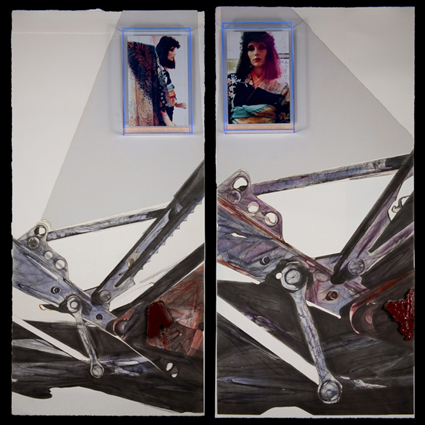
TOKYO/UPSURGE/KIMONO I & II
graphite, conte, photograph, tinted, transparent Plexiglas, enameled hardware
h56" x w50" (combined), 2007
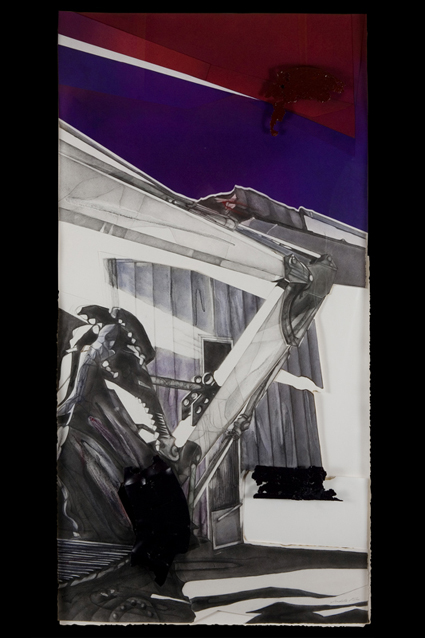
TOKYO/UPSURGE/BROKEN SUN
graphite, conte, enameled hardware,
h56" x 26", 2005
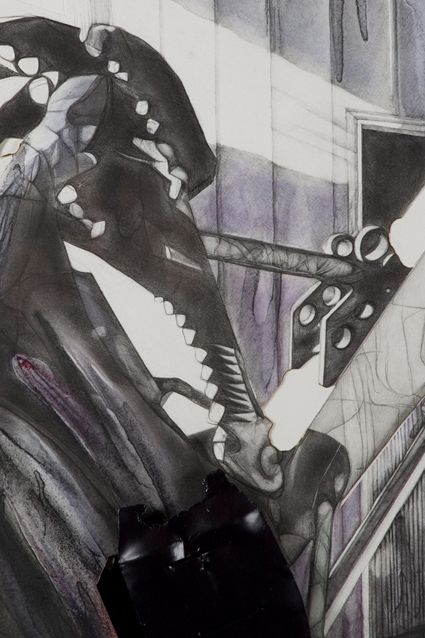
TOKYO/UPSURGE/BROKEN SUN, detail
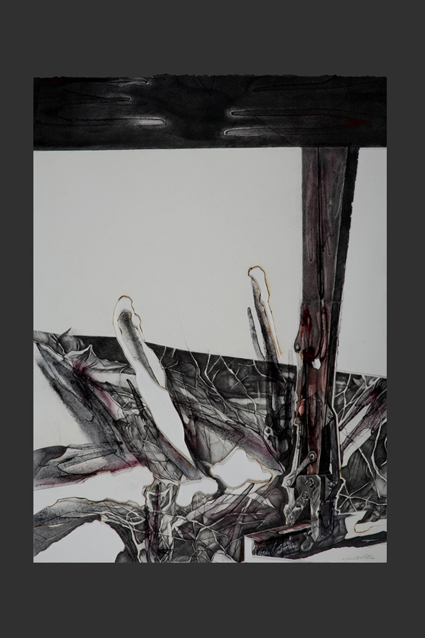
RECLAMATION III
graphite, burned edges
h30" x
w18", 2008