Jonathan Borofsky, the Per Contra Interview with Miriam N. Kotzin - Part 2
PC: When you say prayer, are you directing it? Are you thinking in a theological sense, prayer?
JB: Very quickly, in terms of religion, I don’t follow traditional religions of any kind, although a little bit of Buddhism interested me in the sixties and seventies. That seemed to get the closest to what maybe I was thinking about. So I always say I have my own religion, so start with that. And then the “prayer” is really just positive energy sent out into the world. Period. That’s it. Into the world. Despite doing it here in my studio. That’s the prayer.
It doesn’t have to go anywhere. I’m not sending it to anyone or any god in particular. I’m just creating the energy and sending it out. And it would be ideal if it contributes to other people’s energies that are also doing the same thing.
PC: That seems to be a theme in your work.
JB: Well, it’s an ideal. You know, then again, watching the news on a nightly and daily basis and being part of a government that’s not helping at this point to do that, it’s quite a challenge to keep going on a positive note. You can just become an anarchist and do some very bad things here to try to stop this craziness from all directions. Or do what you can do. I’m just an artist. You know, I’m not a fighter. I’m not an anarchist. So all I can do is make things that soothe my soul, make me feel like I’m contributing. Contributing. Period.
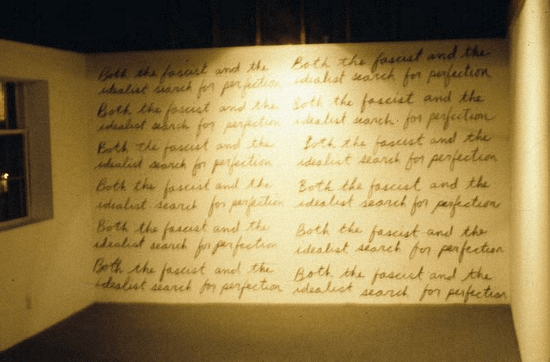
Both the fascist and the idealist search for perfection, Margo Levin Gallery, 1990
PC: I hope you don’t mind this segue, but in your music, “Radical Songbirds of Islam,” there’s an Arabic phrase at the top of the page. What does it say?
JB: It says “All is one.” That early recording was mastered on tape, before CD’s were around. That dates it. That lets you know it was done In the 80’s. Way before the Arab world, and oil, and Khomeni, and Iraq became even issues in our lives. As a child, I was always attracted to Arabic cultures because they seemed so different from my own.
As I say on the liner notes of the tape, I was preparing an exhibition at the Israel museum in the eighties, and, for just a few weeks, to do that show, I was living in Jerusalem next to Old Jerusalem, and was waking up every morning, hearing these Muslim chants on the loudspeakers and on the radio as well. They were fascinating to me because they had no beat to them, and they’d just stop. . . .And then there’d be this long pause, and you’d think, “Oh, it must be over.” And then, pause, pause, pause ,and, out of nowhere, the singing would go on again. Well, this is so antithetical to America’s music, which is based on a steady, continuous beat: thump, thump, thump, thump. And it just seemed so radical to me. There was no traditional Western beat.
And so when I came home, I sat down with Ed Tomney, my music partner at that time, and we devised a computer program based on my counting numbers, drawing on previously recorded notes that I had been singing a capella. That’s how we made this recording. No drum machines, just silence between the voice work.
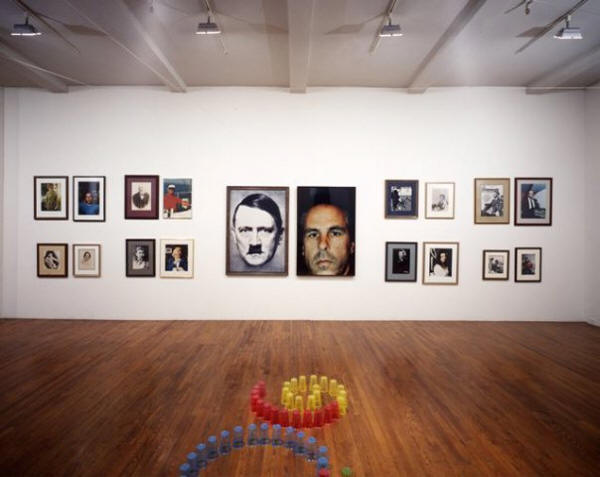
Hitler Wall, Paula Cooper Gallery, 1993
PC: Do you still do music?
JB: Yes, I have a small area upstairs here in my studio for recording voice and instruments. Actually, for the last few months I’ve stopped. I was very obsessed for a while. I think that’s normal, I get very.... and the newest stuff, the newest stuff is not on the website at all.
Nothing new is on the website, my website. Everything there stops around 2001 or two. Maybe the proposal for the 9-11 is the last thing that probably on there. But all the new work, I just haven’t chosen to put on. Mainly because I keep talking about making a new website, and it just never happens because there’s not enough time. And also the new music isn’t on there either. But we’re getting organized and almost ready to update it.
But that’s pretty good, pretty good work from that period. I like the CD that came out from the Jonnie Hitler period. I took on that persona and used the Jonnie Hitler music in conjunction with an exhibition at the Paula Cooper Gallery in the early nineties. As part of the show I exhibited a photograph of me next to a picture of Hitler; a picture of Hitler’s mother, next to a picture of my mother; and a picture of Hitler and his dog next to a picture of me and my dog; and a picture of Hitler giving a speech at the podium in Germany and a picture of me giving a speech at the podium in Germany actually at the dedication of my Hammering Man when I was there.
And part of that exhibition was also to make a CD of music. I took a lot of my songs and re-recorded them backwards. Not that we haven’t heard of backward music before, whether it was the Beatles or whatever else.
And so the entire album is all recorded backwards. Again, that was around l990-91, that CD’s on my website. It still sounds good to me. It fascinates me because now that it’s backwards, it sounds very Muslim-like, chant-like, African-like, almost the opposite of what the music was originally. Because many of these songs that I re-recorded backwards were not chants, they were songs with words more similar to the other CD that I have on the website, titled Compilation, that has actual songs with words that I wrote and sang.
PC: [Quoting lyrics:] “Scrape a rock, scrape a knee, scrape your love right off of me.”
JB. That came at the time of my divorce from my first wife. So the songs from that period were very personal. That particular song came during the period I was out in LA. I had a big music studio out there. The words just flew out. That was the last set of songs where I did write with lyrics.
In general I don’t like writing words for songs.
These days it’s mostly acoustic voice work. Most of my songs get written pretty quickly, in an hour or so they flow out when they come. I really prefer singing chants without words. It makes [with laughter] it makes more sense to me.
And now I’m just beginning to work with a friend and bring the computer back in—to to play a little more with the voice. And so we’ll see where that leads when I get a chance. It’s been a while, but...
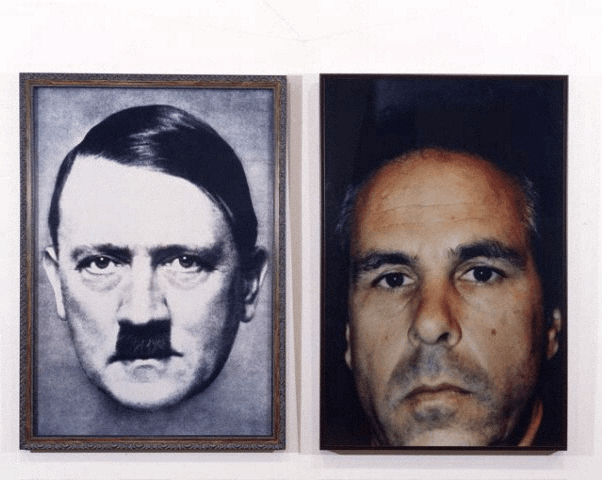
Portrait of Hitler, Portrait of Myself, 1993
PC: One of the images on the website was of a digital organ?
JB: Yeah, well, yeah.
PC: Could you say a little bit about that? Did you use it?
JB: That was an exhibition at Paula Cooper Gallery in the late eighties, again part of an installation. Those installations were always conceived as many parts coming together to create a whole. And this pipe organ was pretty much in the center of the grouping of works.
Around it were many life-size figures made from a hard clay-like substance, projecting lights out of their foreheads onto the walls. And I won’t go into all the other things, but it was a particularly spiritual show. Let’s put it that way.
It was a pipe organ. I had the pipes made by a traditional pipe maker, in I forget which town in the Mid-West. The instrument was computer programmed to blow air through each pipe. The computer digitally translated each note of my voice to a note to be played by a corresponding organ pipe. The notes of my voice, transmitted through a digital keyboard, ultimately emerged as traditional pipe organ sounds. The organ was in a circular shape and you could walk in and sit down inside, with the pipes surrounding you. It’s in storage somewhere.
As I’ve said, everything I make is part of a larger installation, always to be seen in connection with everything else. Hence, in these earlier installations, I used to number everything to make that point. It was all tied together. But that was a good moment. It created...
I always liked to have sound in my earlier installations. I still do. Even in the recent show at Deitch Projects, which I did a couple of years ago, I continued to use sound. The title of the Deitch show was Human Structures and Prayer for Respectful Moralities. My singing seemed to bathe the exhibition with my own emotional nuances.
PC: It also directs people a little bit?
JB: Yeah. It also captures the space. You know, it ties it all together. It just ties everything together. No matter what work you’re looking at, or walking through something into something else, there’s the sound going on so that it just ties everything together in a way.
I don’t like—I’ve said several times in different ways—I don’t like my art being read too much as a salable object, and “how much does this object cost?” and spending too much time with the object-ness as much as the psychology, the idea—the feeling that everything is connected, the fact that it’s all part of a larger philosophy.
It’s my sound, you know, it’s personal. I’m not going to go out and get a record by somebody and play it-- although I wouldn’t be against that, somebody else doing it-- but to be able to interject my own voice, with my own emotions, into the space is part of the installation.
PC: So it’s almost the opposite of a public sculpture that’s outdoors....where there’s much less control.
JB: In part, yes, I’m going from exhibitions like those that went around the States in the eighties and then went to Japan. I think it had 145 pieces in it, so it covered three floors of the museum, the Tokyo Metropolitan Museum. There’s some control for me in that everything in those early installations were signed with a number from my counting system. That’s one way. And there was music, there was sound, each room of the exhibition had a lot of these chattering figures. Just a lot of different things going on in a controlled interior space. And suddenly, outdoors, there’s just one piece, really. And instead, the sounds and energy come from the real world moving around the sculpture.
So the outdoor work becomes a singular effort, it’s not in the protective and controlled environment of an art space, especially a museum space, which was highly protective, at least in the seventies and eighties when I was doing these kinds of installations, of any public interaction or any public chaos I wanted to create. Now the singular sculpture is just sitting out there in the public environment, part of everyday life and let’s just say, in Frankfort for instance, 20,000 people drive by Hammering Man every day.
It’s kind of a daunting task to make sure that I’m not wasting people’s time or energy, or even putting something out there that might hurt people, psychologically, I mean. The sculpture needs to become a symbol positive for something in their lives. So in that sense it is a challenge, and now it’s gone from the many disparate parts connected together as one in an indoor installation to the singular effort set outside amongst the many facets of everyday life.

Borofsky meets with students from local college in Beijing.
But then again, this sculpture that I’m now starting to...the one I explained that’s being made in Beijing for the Olympics, this one has the idea and the feeling of “the many” into it. It is constructed of many figures holding together to create a oneness. And there’s a new commission for San Francisco that we are working on now, in which again many of these life-size figures are connecting together to form a complete structure.
And, in fact, this latest series connects back to my sculpture Walking to the Sky, which has a series of also take “the many” and tie them together into one, the many figures. And, in fact, it’s going back to this older idea, which is still, for me, an excellent idea, of my sculpture Walking to the Sky. Walking to the Sky is composed of a series of humanity, different representations of people, a male, a female, a child, an older person, people with different skin colors, all connected together as one, as they walk up this hundred-foot tall stainless steel diagonal line towards the sky. So I guess I continue in these newest works to illustrate this idea of “many as one” and “one as many.”
PC: Thank you. I appreciate your having given our readers an idea of the philosophical and psychological background of your work.